 By
By A controversial statue installation near the White House and the National Mall in Washington, D.C. has triggered widespread public attention, political reactions, and legal questions about protest art in public spaces.
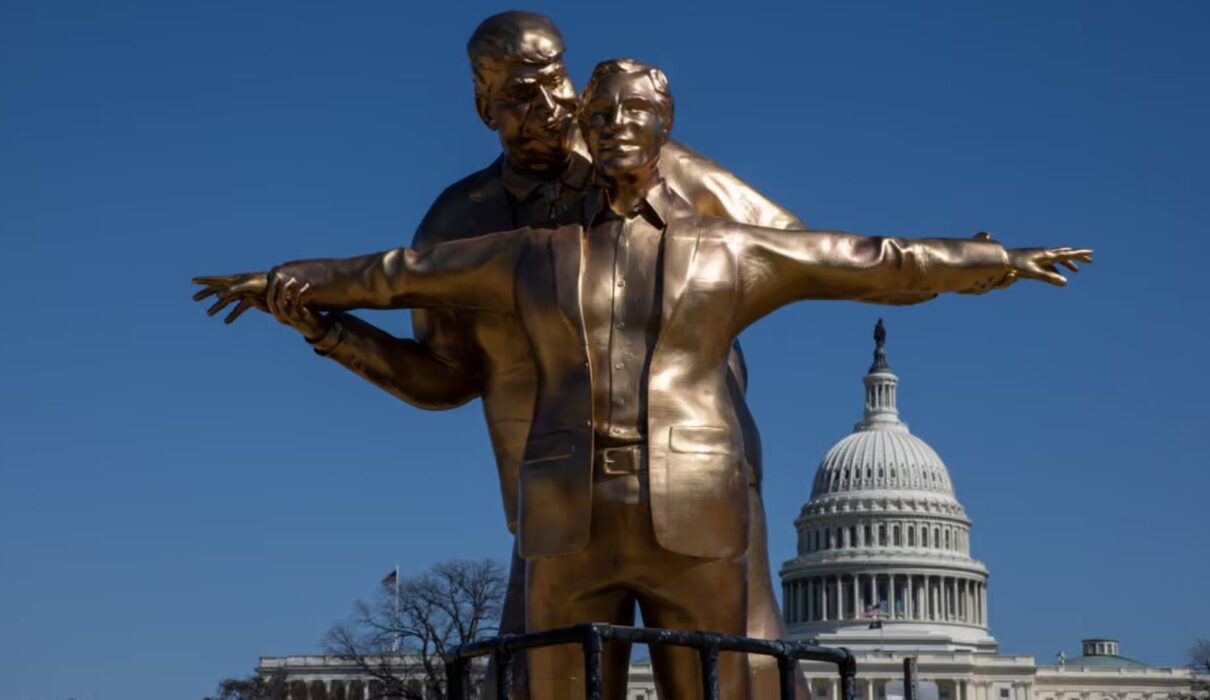
The sculpture, titled “King of the World,” appeared earlier this week and quickly went viral on social media. The artwork depicts Donald Trump standing behind Jeffrey Epstein in a pose inspired by the famous scene from the movie Titanic, where the characters stand at the bow of the ship with arms outstretched.
According to reports, the statue stands roughly 12 feet tall and was placed on the National Mall by an anonymous artist collective known as The Secret Handshake. The group said the installation was intended as a form of political commentary addressing past associations between the two figures and broader issues of public accountability.
A plaque attached to the statue references themes from the film Titanic, drawing parallels between the fictional story and the relationship portrayed in the sculpture. The text mentions elements such as “luxurious travel, raucous parties and secret sketches,” a phrase widely interpreted as a critical message directed at the individuals represented in the artwork.
The installation quickly attracted crowds, photographers, and journalists. Visitors gathered around the statue, taking photos and debating the political message behind the artwork. Within hours, images of the sculpture began circulating widely across major social media platforms.
Officials associated with the White House criticized the statue and described it as politically motivated. Some government representatives questioned whether the artwork unfairly targeted political figures and argued that similar artistic protests should be applied consistently across different political figures and public controversies.
Despite the criticism, legal experts say that installations like this often fall under protected political expression in the United States. Public art used as protest or commentary frequently raises questions about First Amendment rights, public permits, and the regulation of temporary structures on federal land.
The National Mall has historically been a major location for political demonstrations, protest art, and public activism. Over the years, various temporary installations have appeared there to comment on political issues, social movements, and government policies.
Authorities have not yet confirmed whether the statue received an official permit or how long it will remain in place. In previous cases, similar installations have been removed within days if they violated park regulations or lacked proper authorization.
For legal analysts, the situation highlights an ongoing tension between free expression and government regulation of public spaces. While the U.S. Constitution strongly protects political speech, federal land authorities still maintain rules governing safety, permits, and the use of public monuments.
As debate continues in Washington, the statue has already succeeded in generating national attention. Whether it remains on display or is removed by authorities, the installation has once again demonstrated how art can become a powerful tool in modern political discourse.
