
 By
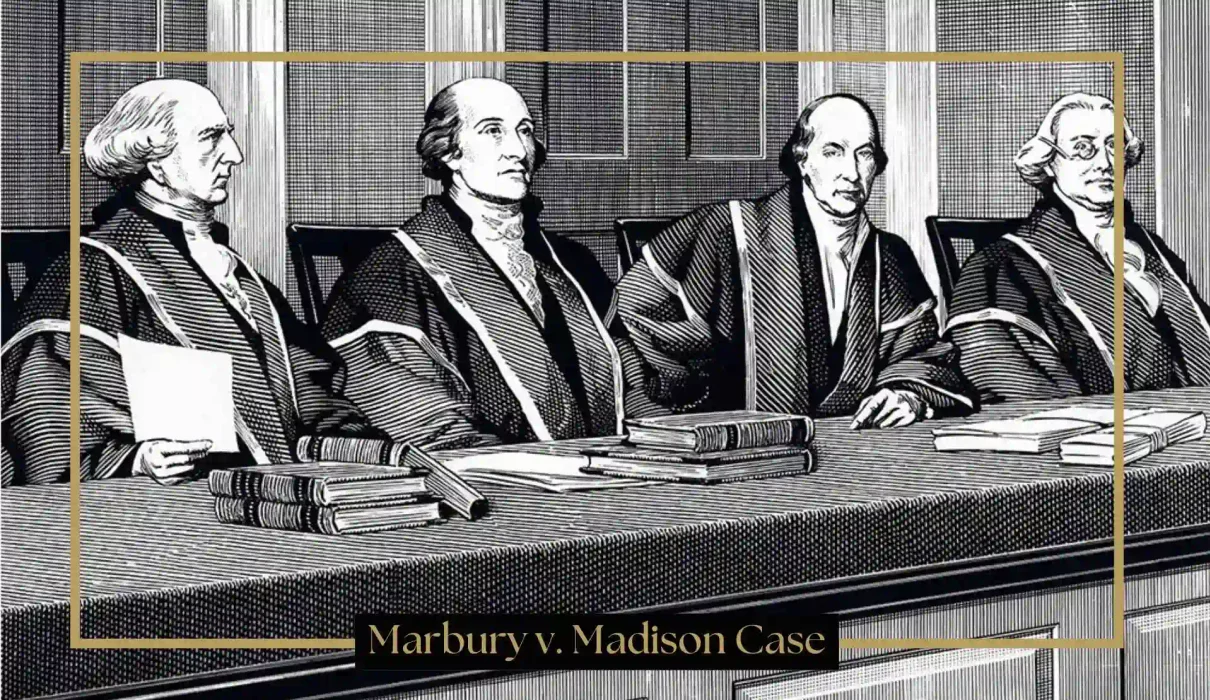
By This Marbury v. Madison case brief breaks down the facts, the issue, the holding, and the reasoning behind the single most cited decision in American constitutional law. Decided on February 24, 1803, Marbury v. Madison, 5 U.S. (1 Cranch) 137 (1803) gave the Supreme Court the power of judicial review, the authority to strike down a federal law that conflicts with the Constitution. Every marbury v. madison case brief written since 1803 starts from the same place: a political fight over a handful of unsigned paperwork that turned into the foundation of American constitutional government.
Below is a complete, attorney-level breakdown of the case: what happened, the facts the Court relied on, the legal questions it answered, the holding, and why this single ruling still shapes every major constitutional dispute in the United States.
At a Glance: Marbury v. Madison Case Snapshot
| Case Name | Marbury v. Madison |
| Citation | 5 U.S. (1 Cranch) 137 (1803) |
| Court | Supreme Court of the United States |
| Argued / Decided | Argued February 11, 1803 · Decided February 24, 1803 |
| Opinion Author | Chief Justice John Marshall |
| Vote | 4–0 (Justices Cushing and Moore recused) |
| Area of Law | Constitutional law, separation of powers, federal judiciary |
| Core Holding | Congress cannot expand the Supreme Court’s constitutional original jurisdiction, and courts may declare an unconstitutional law void. |
What Happened in Marbury v. Madison? A Quick Summary
Here is a summary of Marbury v. Madison in plain terms: outgoing President John Adams appointed William Marbury as a justice of the peace for the District of Columbia during his final hours in office. The signed commission was never delivered before Adams left. When Thomas Jefferson became president, his new Secretary of State, James Madison, refused to hand it over. Marbury asked the Supreme Court to order Madison to deliver it through a writ called a mandamus.
Chief Justice John Marshall agreed that Marbury had a right to the commission and that the law should have given him a remedy. But Marshall also found that the specific law Marbury relied on to bring his case directly to the Supreme Court, Section 13 of the Judiciary Act of 1789, conflicted with Article III of the Constitution. Faced with a statute that clashed with the Constitution, Marshall ruled that the Constitution wins. That single move, striking down an act of Congress for the first time in American history, created the doctrine of judicial review.
Marbury v. Madison Facts: How a Last-Minute Appointment Became a Constitutional Fight
The Marbury v. Madison facts begin with one of the most contentious elections in early American history. The Federalist Party, led by President John Adams, lost the election of 1800 to Thomas Jefferson’s Democratic-Republicans. Adams remained in office until March 4, 1801, and in the weeks before Jefferson’s inauguration, the outgoing Federalist Congress passed the Judiciary Act of 1801.
That law reshaped the federal courts. It created new district courts, added circuit judgeships, expanded presidential control over judicial appointments, and even reduced the number of Supreme Court seats from six to five so that Jefferson could not immediately fill a vacancy. Adams used the new law to appoint 16 circuit judges and 42 justices of the peace for the District of Columbia before leaving office. History remembers these last-minute appointees as the “Midnight Judges.”
William Marbury, a Federalist supporter from Maryland, was one of those 42 appointees. The Senate confirmed him, and Adams signed his commission. At the time, John Marshall was serving simultaneously as Chief Justice and as Adams’s outgoing Secretary of State, and it was Marshall’s job to deliver the signed commissions. In the final rush before the transfer of power, a handful of commissions, including Marbury’s, were never delivered.
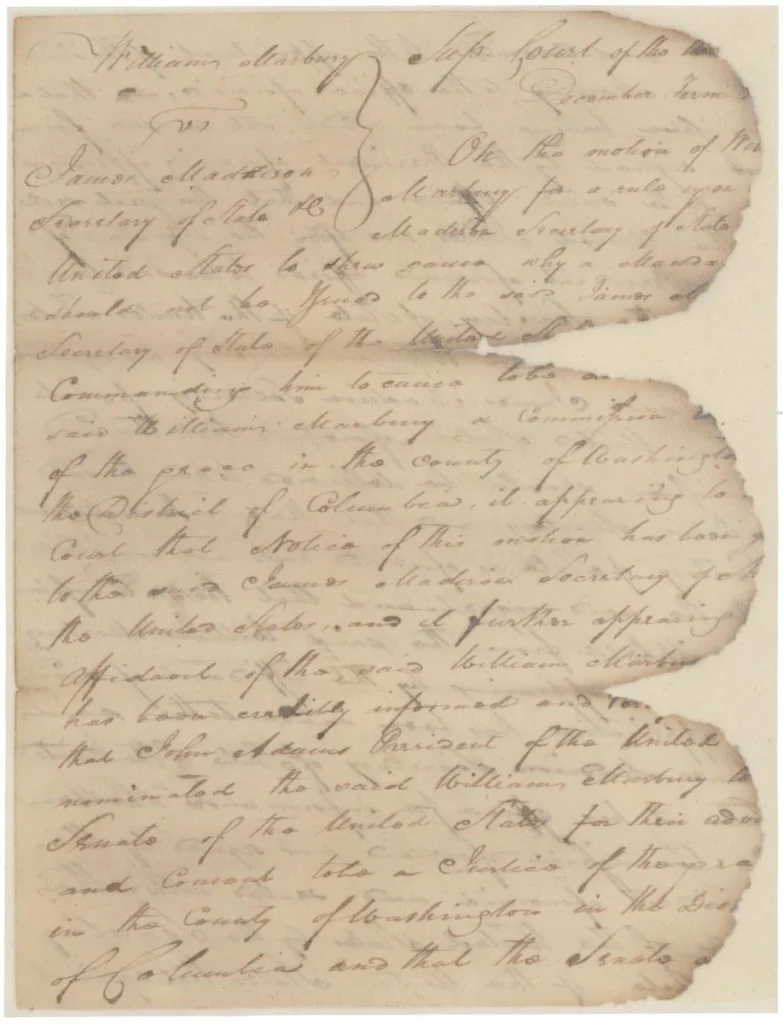
When Jefferson took office, James Madison became the new Secretary of State. Jefferson viewed the undelivered commissions as void and instructed his administration to withhold them. The new Democratic-Republican Congress went further, repealing the Judiciary Act of 1801 and canceling the Supreme Court’s entire 1802 term to delay any challenge from reaching the bench. Marbury, along with three other undelivered appointees, filed suit directly with the Supreme Court, asking for a writ of mandamus ordering Madison to hand over the commission. Full details of the underlying record, including the original affidavits and the Court’s own account of the dispute, are preserved in the Court’s opinion at Justia’s U.S. Supreme Court archive.
What Facts of the Marbury v. Madison Case Were Presented to the Court?
Marbury’s attorney, Charles Lee, a former U.S. Attorney General, supported the request with sworn affidavits establishing several points: that Adams had nominated Marbury and the Senate had confirmed him; that the commission was signed and sealed in proper form; that Marbury had formally requested delivery from Madison and been refused; and that the Secretary of State’s office would not even confirm whether the commission had been signed. James Madison declined to appear in court or respond, apparently on the theory that the Court had no authority over the executive branch in this matter.
- That Marbury, Dennis Ramsay, Robert Townsend Hooe, and William Harper had each been nominated by President Adams and confirmed by the Senate.
- That commissions in proper legal form were signed by the President and sealed by the Secretary of State.
- That each applicant had formally requested delivery of his commission and been refused.
- That the Department of State would not confirm, even informally, whether the commissions had been signed.
- That the Senate secretary declined to certify the record of the nominations when asked.
Because Madison never appeared to contest these facts, the Court treated them as established and proceeded to the legal questions they raised.
The Legal Questions the Court Had to Answer
Chief Justice Marshall organized the entire opinion around three questions, and the structure he used has shaped how lawyers brief cases ever since:
- Did Marbury have a right to the commission he demanded?
- If that right was violated, do the laws of the United States give him a remedy?
- If a remedy exists, is a writ of mandamus from the Supreme Court the correct one?
The first two questions were, in Marshall’s view, straightforward. The third question was the one that mattered for the future of the country, because answering it required the Court to decide whether Congress could hand the Supreme Court a power the Constitution did not give it.
The Holding: What the Supreme Court Decided
The Court held that Marbury did have a vested legal right to his commission the moment Adams signed it and the Secretary of State sealed it; delivery was a purely administrative, non-discretionary act. The Court also held that a legal right without a remedy is not a right at all, so the law did provide Marbury a remedy in principle.
On the third question, however, Marbury lost. Section 13 of the Judiciary Act of 1789 purported to let the Supreme Court issue writs of mandamus as a matter of original jurisdiction, meaning Marbury could file directly with the Supreme Court instead of starting in a lower court. Article III of the Constitution, by contrast, lists only a narrow set of cases, those involving ambassadors, public ministers, and disputes where a state is a party, in which the Supreme Court has original jurisdiction. Everything else is appellate jurisdiction only. Marbury’s case did not fit within that narrow list.
Marshall concluded that Congress had tried to expand the Supreme Court’s original jurisdiction beyond what the Constitution allows, and that Congress has no power to do that through an ordinary statute. Because the statute conflicted with the Constitution, and because the Constitution is the supreme law of the land, the offending part of Section 13 was void. The Supreme Court therefore had no authority to issue the writ Marbury asked for, and his case was dismissed even though the Court agreed he had been wronged.
Marshall’s own words, from the opinion itself, remain the most quoted line in American constitutional law: it is “the province and duty of the judicial department to say what the law is.” Encyclopaedia Britannica summarizes the lasting result this way: the ruling is considered one of the foundational pillars of U.S. constitutional law, as explained in its overview of the case.
Marbury v. Madison Case Brief (IRAC Format)
For readers who need a structured brief to cite or study from, here is the case broken into the standard Facts, Issue, Rule, Analysis, and Conclusion format used in most American law schools.
Facts
William Marbury was appointed a justice of the peace for the District of Columbia by outgoing President John Adams in the final days of his term. The commission was signed and sealed but never delivered before Adams left office. The incoming Secretary of State, James Madison, refused to deliver it on President Jefferson’s instructions.
Issue
Does the Supreme Court have the authority, under the Constitution, to issue a writ of mandamus compelling delivery of the commission as a matter of original jurisdiction?
Rule
Article III, Section 2 of the Constitution limits the Supreme Court’s original jurisdiction to cases involving ambassadors, public ministers, and consuls, and cases where a state is a party. In every other case, the Supreme Court’s jurisdiction is appellate only. A federal statute that conflicts with the Constitution is void and unenforceable.
Analysis
Section 13 of the Judiciary Act of 1789 attempted to authorize the Supreme Court to issue writs of mandamus as an original matter in cases not listed in Article III. Because the Constitution is the supreme law and Congress cannot alter it through ordinary legislation, the conflicting portion of Section 13 could not stand. Courts, not Congress, have the final word on what the Constitution permits.
Why Is Marbury v. Madison the Most Important Case?
Marbury v. Madison is widely treated as the most important case in American constitutional history because it answered a question the Constitution itself never explicitly settled: who gets the final word on whether a law is constitutional? Marshall’s answer, the judiciary, became the backbone of the American system of checks and balances. Without judicial review, Congress and the President would effectively police their own compliance with the Constitution, with no independent branch able to say otherwise.
Every major constitutional ruling since 1803, from Brown v. Board of Education to modern disputes over federal regulatory power, rests on the authority Marshall claimed in this case. US Supreme Court decisions that could reshape business regulations continue to draw on that same power of judicial review more than two centuries later, which is why law students, journalists, and practicing attorneys still treat this single 1803 opinion as the starting point for understanding how American courts check the other branches of government.
Can You Explain Marbury v. Madison to Kids?
Yes, and the plain-language version holds up well even for a classroom audience. A president signed a piece of paper giving a man a new job. The paper never got delivered before the president left office, and the next president’s team refused to hand it over. The man asked the Supreme Court to force them to deliver it.
The Supreme Court said two things. First, that the man was right and deserved the paper. Second, that the Court itself was not allowed to order it delivered in that particular way, because the rule Congress had written giving the Court that power broke the Constitution’s own rules. So the judges made a bigger point instead: whenever a law and the Constitution disagree, the Constitution always wins, and it is the job of judges to decide when that happens. That is the idea, in a single sentence, that still shapes how every American court works today.
The Lasting Impact of Marbury v. Madison
The doctrine of judicial review did not appear overnight as a fully formed tool. The Supreme Court did not strike down another federal law for more than fifty years, until the Dred Scott decision in 1857. But once established, the principle became permanent. Today, judicial review is the mechanism courts use to decide whether a law violates free speech protections, due process, equal protection, or the separation of powers, and it remains central to the kind of litigation that shapes American business and civil life. For a broader look at how landmark rulings have reshaped entire industries, see Lawsuits That Changed the Way Businesses Operate on Attorneys Magazine.
As the legal analysis site iPleaders notes in its own breakdown of the case, Marbury v. Madison was the first case in which a national supreme court struck down an act of its own legislature as unconstitutional, a template later borrowed by constitutional courts around the world, as discussed in its in-depth case analysis.
Frequently Asked Questions About Marbury v. Madison
What is Marbury v. Madison in one sentence?
It is the 1803 Supreme Court case that established judicial review, the power of federal courts to strike down laws that conflict with the Constitution.
Did William Marbury ever get his commission?
No. Even though the Court agreed he had a legal right to it, the case was dismissed on jurisdictional grounds, and Marbury never served as a justice of the peace.
Who wrote the opinion in Marbury v. Madison?
Chief Justice John Marshall wrote the unanimous opinion, joined by Justices William Paterson, Samuel Chase, and Bushrod Washington. Two justices, William Cushing and Alfred Moore, did not participate.
What part of the Judiciary Act of 1789 was struck down?
The portion of Section 13 that purported to give the Supreme Court original jurisdiction to issue writs of mandamus in cases beyond those listed in Article III of the Constitution.
Why do law students still brief this case first?
Because it introduces, in one compact set of facts, nearly every core concept in American constitutional law: separation of powers, the supremacy of the Constitution, and the judiciary’s role as a check on the other two branches.
Final Takeaway
Marbury v. Madison turned an ordinary political dispute over a single unsigned commission into the case that defines how American courts relate to Congress and the President. Whether you are studying for a constitutional law exam, researching for a brief, or just trying to understand why courts can strike down a law in the first place, this case is the starting point, and understanding its facts, issue, and holding is the fastest way to understand the rest of American constitutional law.
The article was written by Adam Fermin, reviewed by Allen Winston Grubman, and last updated on October 12, 2026.