 By
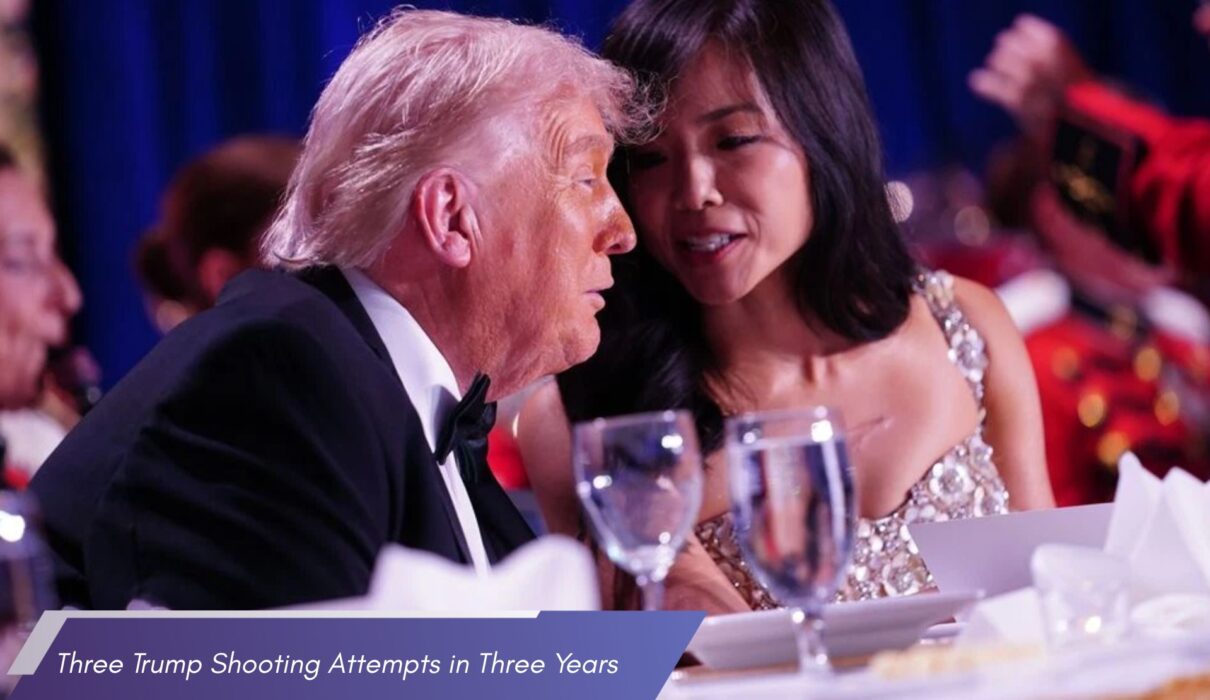
By A gunman stormed the White House Correspondents’ Dinner on Saturday night, making it the third confirmed shooting incident targeting Donald Trump since July 2024. Is America witnessing a new wave of political violence — or something more politically calculated?
Washington was shaken again on Saturday evening when Cole Tomas Allen, a 31-year-old California engineer and teacher, charged a security checkpoint armed with multiple weapons outside the ballroom of the Washington Hilton — where President Donald Trump, First Lady Melania Trump, and Vice President JD Vance were seated at the annual White House Correspondents’ Dinner. A Secret Service officer was struck by at least one round but was protected by a bulletproof vest and is expected to be okay. None of the attendees were seriously injured. The suspect was apprehended at the scene and is now in federal custody.
It marks the third major Trump shooting attempt in under three years — a streak with no modern presidential parallel. And with each incident, the same questions resurface with growing urgency: Are these the acts of isolated, radicalized individuals? Or does the pattern reveal something deeper about the current state of American political tension?
The Current Count
- 3 — Shooting Attempts Since July 2024
- 2.75 — Years Between First & Latest Incident
- 0 — Successful Hits on the POTUS
The Three Trump Shooting Attempts — A Timeline
| July 13, 2024 — Butler, PA Thomas Matthew Crooks, 20, fired eight rounds from a rooftop at a campaign rally. A bullet grazed Trump’s right ear. One attendee, Corey Comperatore, was killed; two others were critically wounded. Crooks was shot dead by Secret Service seconds after opening fire. |
| Sept. 15, 2024 — West Palm Beach, FL Secret Service agents spotted Ryan Routh hiding with a rifle in the tree line near Trump International Golf Club. Agents fired at Routh, who fled in a vehicle and was later captured. He was subsequently sentenced to life in prison. |
| April 25, 2026 — Washington, D.C. Cole Tomas Allen, 31, of Torrance, California — a Caltech-trained engineer — forced his way through a security checkpoint at the Washington Hilton during the White House Correspondents’ Dinner. Trump, Melania Trump, and VP Vance were evacuated from the dais. One Secret Service officer was struck but survived thanks to a bulletproof vest. Allen was apprehended at the scene. |
The math is blunt: three confirmed incidents in roughly 33 months. At that rate — statistically speaking — we could expect two more such attempts before Trump’s current term ends. That is not a prediction; it is a sobering projection that demands serious scrutiny of both security infrastructure and the political climate producing these individuals.
Who Is Cole Allen — and What Was His Motive?
The suspect calls himself a “Friendly Federal Assassin” in the written manifesto he emailed to family members shortly before the attack. The manifesto clearly stated he wanted to target officials in the Trump administration, and authorities found anti-Trump and anti-Christian rhetoric across his social media accounts. Allen’s own brother notified police after receiving the document.
A Bluesky account believed to belong to Allen included recent posts critical of Trump and his administration’s policies, as well as opposition to the U.S. war with Iran and Russia’s ongoing conflict in Ukraine. Allen graduated from Caltech in 2017 and had previously interned for NASA — his professors described him as an exemplary, soft-spoken student. To the outside world, he was a Teacher of the Month at a California tutoring firm. To investigators, he is now a would-be assassin.
Trump addressed the Iran connection directly, telling reporters it was unlikely the shooting was linked to the ongoing U.S.-Israel war with Iran, though he acknowledged he couldn’t say for certain. “It’s not going to deter me from winning the war in Iran,” the president said. Acting Attorney General Todd Blanche confirmed investigators believe Allen was targeting administration officials specifically, though motive remains under active investigation.
“A man charged a security checkpoint armed with multiple weapons, and he was taken down by some very brave members of the Secret Service.”
— President Donald Trump, White House press briefing, April 25, 2026
Real Threat or Staged Political Theater? The Questions Being Asked
Each time Trump survives a shooting attempt, two parallel conversations break out simultaneously — one about security failures, and one about whether anything was staged for political effect. It is a cycle that says as much about our fractured information ecosystem as it does about any individual incident.
After the Butler, Pennsylvania shooting in July 2024, a Morning Consult poll taken two days after the shooting found that roughly one in five Americans considered it credible that the event had been staged — including a third of Biden voters at the time. Now, with the WHCA dinner incident, social media platforms once again lit up with “STAGED” posts on Bluesky, echoing the response to Butler, with some on X claiming the shooting was designed to boost support for Trump’s controversial White House Ballroom construction project.
It is worth asking why these narratives keep gaining traction — even among people who once supported Trump. Right-wing commentators including Tucker Carlson and Tim Dillon have floated conspiracy theories about Butler, with Dillon going so far as to say “I think maybe it was staged.” Other theories have predictably involved Israel — including the idea that Trump is beholden to or compromised by the Jewish state, with some critics linking unanswered questions about Butler to Trump’s decision to go to war with Iran.
The staged narrative framework tends to follow a consistent logic: the timing is too convenient, the optics are too perfect, and the political beneficiary is obvious. But the publicly documented record — federal and local investigations, contemporaneous eyewitness reporting, and independent fact-checking — found no credible evidence any of the Trump shooting attempts were faked. Thousands of witnesses, credentialed journalists, and forensic evidence all point to genuine attacks.
That said, the “staged” question is not entirely without basis as a line of inquiry — even if the answer keeps coming back the same way. Why do the security gaps keep appearing? Why, after the most scrutinized security failure in a generation at Butler, was a hotel guest able to check in the night before a presidential dinner and breach a checkpoint with multiple weapons? These are not conspiracy theories. They are legitimate accountability questions — ones that constitutional attorneys and national security analysts will be wrestling with for months.
The Iran War, the Israel Factor, and Venezuela: Connecting the Dots
The geopolitical backdrop to these shooting attempts is impossible to ignore. The United States is currently engaged in an active military conflict with Iran, a war that has been deeply controversial — generating mass protests, sharp international criticism, and profound domestic unease. Trump himself dismissed any connection between the 2026 Iran war and the WHCA dinner shooting, but the shooter’s own social media posts suggest at least a personal preoccupation with U.S. foreign policy in the region.
Meanwhile, conspiracy theories connecting the shooter to Israel circulated rapidly — allegations emerged online that the suspect’s name had been heavily searched in Israel before the incident, and that Allen had been seen wearing an IDF sweatshirt. Neither claim has been officially confirmed. What is true is that Joe Kent, a former top Trump administration counterterrorism official who resigned over the Iran war, has hinted at “darker” explanations linking unresolved questions about Butler to Trump’s motivations for the Iran conflict.
Add to this the broader geopolitical climate — U.S. pressure campaigns on Venezuela, ongoing energy and communication disruptions affecting Cuba, and a White House operating under wartime conditions — and it becomes clear that someone with extreme political grievances today has no shortage of fuel. The question is not whether people are angry. They clearly are. The question is what turns that anger into a man boarding a cross-country train with a loaded weapon and a manifesto.
Three Shooters. Three Different Profiles. One Alarming Pattern.
What makes this string of attempts uniquely troubling is the diversity of the perpetrators. Thomas Matthew Crooks was a registered Republican who had donated to a progressive voter group. Ryan Routh was a self-styled military recruiter with a history of erratic behavior. Cole Allen is a highly educated engineer, a NASA intern, a teacher of the month — someone who, by all external measures, should not end up in a federal arrest photo.
These are not the profiles of a coordinated movement. They appear to be individuals who, acting alone, reached a personal breaking point and chose the most visible possible target. That, in some ways, is more frightening than an organized plot — because there is no network to dismantle, no financing to freeze, no leadership to prosecute. There is only the next grievance, and the next individual who decides to act on it.
Trump himself, speaking on CBS’s 60 Minutes the morning after the dinner shooting, acknowledged the historical weight of the moment. “You go back 20 years, 40 years, 100 years,” he said, “it’s always been there.” That is true. But three attempts in under three years — with America at war, with political polarization at historic highs, and with a president who commands fierce loyalty and fierce hatred in equal measure — suggests the current moment is not ordinary history. It is something that demands more than Secret Service bravery. It demands a reckoning.
What Happens Next — Legally and Politically
Allen has been charged with two counts of using a firearm during a crime of violence and one count of assault on an officer using a dangerous weapon. U.S. Attorney Jeanine Pirro stated that further evidence could lead to additional charges. Federal prosecutors will likely pursue a terrorism enhancement, which could mean decades or life in federal prison.
Politically, the incident arrives at a volatile moment. Trump’s approval ratings have been under pressure from the Iran war, economic anxieties, and internal Republican tensions. Critics on both the left and the right are asking harder questions — not just about who is doing the shooting, but about what the cultural and political conditions are that keep producing these moments.
For criminal defense attorneys, this case will raise fascinating and complex questions about federal jurisdiction, mental health evaluations, and the evidentiary weight of a pre-written manifesto. For the rest of America, it raises a simpler question: How many more times?
At the current rate — three confirmed attempts in 33 months — the statistical projection points to at least two more shooting attempts before Trump’s term concludes. Whether that projection reflects a genuine escalation of political violence or a grim coincidence of lone-wolf radicalization, one thing is certain: the pattern cannot be dismissed as an anomaly any longer.
“It’s always been there, people are assassinated, people are injured, people are hurt. But this moment feels different — and pretending otherwise is its own kind of danger.”
— Paraphrase of Trump remarks to CBS News, April 26, 2026, with editorial context
Editor’s note: This article presents verified facts sourced from FBI statements, court filings, and reporting by NPR, CBS News, CNN, Al Jazeera, and Newsweek. Conspiracy theories referenced are presented for journalistic scrutiny — not endorsement. No credible evidence supports claims that any Trump shooting attempt was staged.
