
 By
Quick answer
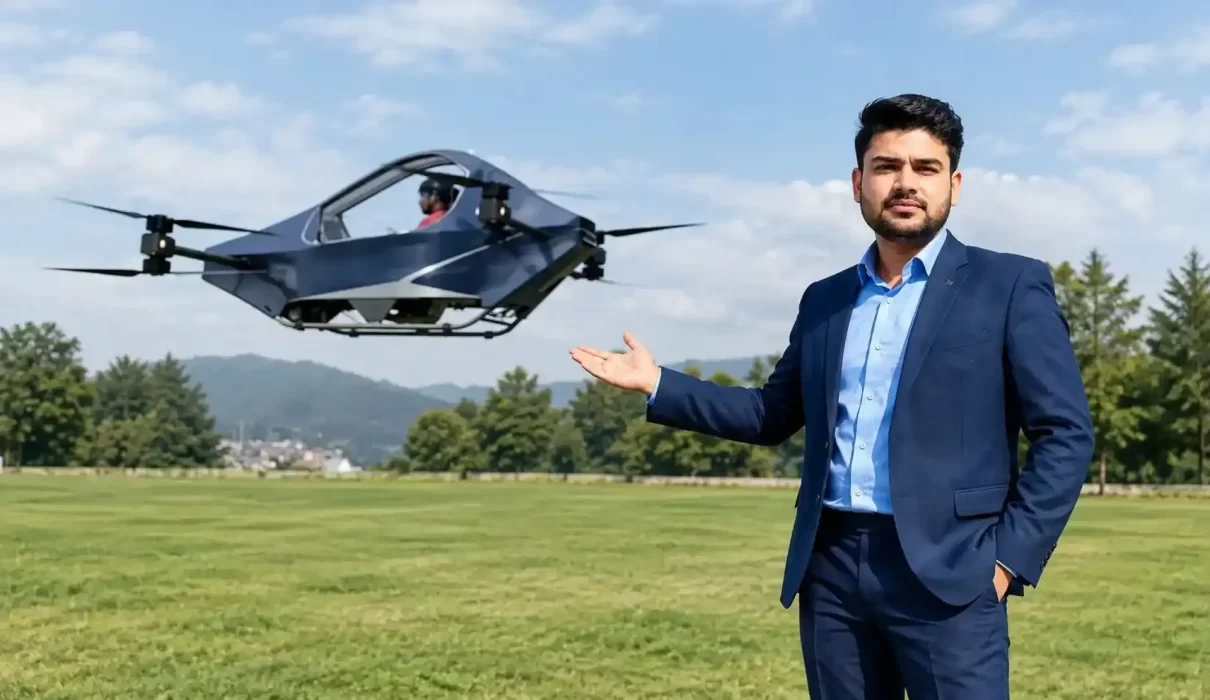
Ravi Tamta is an innovator from Kaflikhan village, near Jageshwar Dham in Almora district, Uttarakhand, India. He runs a startup called Hapida Sky Private Limited, which built the Hapida SKYNeX, a single-seat electric flying vehicle. Media reports say the prototype was test flown in Almora on August 7, 2026. It is still a prototype, it has no announced price, and it needs approval from India’s aviation regulator before anyone can use it commercially.
That is the short version. The rest of this piece covers what was actually shown, which claims are still unproven, and the aviation law a vehicle like this has to clear in India. If you are reading from the US, there is a section on how the FAA is handling the same new category of aircraft.
Ravi Tamta at a Glance
| Detail | What the reports say |
|---|---|
| Name | Ravi Tamta |
| From | Kaflikhan village near Jageshwar Dham, Almora district, Uttarakhand, India |
| Company | Hapida Sky Private Limited, where he is described as founder and CEO |
| Vehicle | HAPIDA SKYNeX, a single-seat, fully electric personal flying vehicle (prototype) |
| Reported test flight | August 7, 2026, in Almora |
| Government reaction | Congratulations from Uttarakhand Chief Minister Pushkar Singh Dhami and Union Civil Aviation Minister Ram Mohan Naidu Kinjarapu |
| Status | Prototype. No price announced. No regulatory approval reported. |
Who Is Ravi Tamta?
Ravi Tamta comes from Kaflikhan, a village near Jageshwar Dham, a pilgrimage site in Almora district. For readers outside India, Almora is a hill district in the Himalayan foothills of Uttarakhand, a state in the north of the country. It is not where most people expect an aircraft startup to come from, and that is a big part of why the story spread.
He is the founder and CEO of Hapida Sky Private Limited, according to Rainbow News, and the company behind the vehicle, according to Business Today. Coverage calls him a young innovator. It does not give his age, his education or any earlier job, so this article does not either. Hindustan Herald reports that he worked largely without institutional funding or lab support. India TV reports that his family backed him through this project and several earlier ones.
How long did the project take?
Reports disagree. Business Today says he has reportedly spent nearly 13 years working toward the vehicle, and Hindustan Herald uses a similar 13-year framing. India TV says he spent about one year building this particular prototype. One reading is that the long figure covers years of research and earlier attempts while the build itself was shorter. No outlet spells that out, so treat any single number with care.
What Is the Hapida SKYNeX?
The SKYNeX is a single-seat, fully electric personal flying vehicle. Reports describe it as a prototype that produces zero tailpipe emissions and runs without aviation fuel. Samsearch classifies it as an eVTOL, short for electric vertical take-off and landing. That is the same family of aircraft that companies in the US and elsewhere have been trying to certify for years.
Several outlets say it is built on drone technology. The Free Press Journal and India TV describe modified drone technology. Hindustan Herald calls it a heavily reworked drone platform and says it is neither a plane nor quite a drone. Chief Minister Dhami’s post on X, in Hindi, praised Tamta for innovating in drone technology, as Business Today notes.
Is it really a car?
The headlines say flying car. The reports I reviewed describe a personal flying vehicle and say nothing about driving on roads. The project slogan, as Rainbow News reports it, translates to “Beyond roads, toward the sky.” So the label is shorthand. Think of it as a one-person electric aircraft first.
What Tamta says it can do
In his comments to India TV, Tamta said the prototype can “cover any distance” and that charging time can be extended as much as desired. Those are his claims, and no measured range, flight duration or battery figure has been published to back them. Business Today notes that range, payload, flight duration, maximum altitude and charging requirements have not been disclosed.
The Almora Flying Car Test of August 7, 2026
Multiple reports place the first test flight on August 7, 2026. India TV says it took place on open ground in Almora, under administrative supervision with safety arrangements in place. Hindustan Herald says the prototype lifted off and stayed airborne for under a minute, in front of local authorities. The same article says claims about an Army-linked facility and named district officials could not be independently verified.
Videos of the flight spread widely on social media. Tamta later posted behind-the-scenes footage on Instagram. He also told the Free Press Journal that he could not speak to the media after the test and that the Almora administration is now handling demonstrations and press requests.
The political reaction came fast. Chief Minister Dhami congratulated him on X on August 7. Per Samsearch, Dhami said there is “no lack of talent, innovation or scientific mindset among our youth.” ePlane AI reports that Union Civil Aviation Minister Ram Mohan Naidu Kinjarapu also praised the work, saying “talent transcends geographical boundaries.”
Later in August, Panchjanya and Rainbow News reported that Tamta met Naidu in person. They discussed personal sky mobility, DGCA approval, testing, safety and certification. Neither report mentions a permit granted, a funding amount or a timeline.
A flight of under a minute is a real milestone, and it is also a very early one. Aviation experts quoted by Hindustan Herald say certification takes years and point out that many flying vehicle prototypes around the world have stalled at this stage.
Why Almora? The 40 Kilometer Problem
Tamta’s stated motivation is simple and local. According to GDN Online, a road trip of about 40 kilometers between his village and home takes nearly 90 minutes. He imagines covering the same distance by air in 10 to 15 minutes. Other reports put it at about 10 minutes, and Hindustan Herald stresses that this is unproven at scale.
The uses that supporters and officials mention are all about terrain. Landslides and floods regularly cut roads in the Himalayas. Reports list remote village connectivity, emergency response, medical transport, disaster relief and mountain tourism. Organiser is careful to call these speculative, and that is the right way to read them. None has been demonstrated.
What Is Confirmed and What Is Not
| Question | Where reporting stands |
|---|---|
| Did a test flight happen? | Reported by multiple outlets, dated August 7, 2026. No independent flight data published. |
| How many seats? | One. |
| Power source | Fully electric, zero tailpipe emissions. |
| Based on a drone? | Several outlets say modified or reworked drone technology. |
| Years of development | Nearly 13 years per Business Today. About one year for this build per India TV. |
| Range, payload, battery, speed, altitude | Not disclosed. Tamta’s “any distance” remark is an unverified claim. |
| Price | Not announced. Business Today says online claims of a confirmed price or imminent launch should be treated with caution. |
| Funding and investors | Not disclosed in any report reviewed. |
| Regulatory approval | None reported. Tamta says he is in talks with DGCA and the government about a permit. |
| Commercial launch date | None announced. Business Today says certification could take several more years. |
The Legal Road Ahead in India
Every flying vehicle story ends at the regulator, so start there. India’s aviation law changed recently. The Bharatiya Vayuyan Adhiniyam, 2024 replaced the Aircraft Act, 1934, and according to Mondaq’s legal overview the Aircraft Rules, 1937 still apply alongside it. The Directorate General of Civil Aviation, or DGCA, is the national regulator.
For eVTOL aircraft specifically, the framework is still being built. Mondaq reports that DGCA has issued Airworthiness Criteria for VTOL-capable Aircraft (AEAC 01/2024) and National Vertiport Guidance, and has set up six working groups covering type certification, crew licensing, air operator permits, drone traffic management and maintenance. Pilot licensing and training rules for eVTOLs are still under development. Operators of urban air mobility services will need air operator permits, much like airlines.
Where does a single-seat vehicle fit?
India’s Drone Rules, 2021 cover unmanned aircraft. Most drones need registration on the DigitalSky platform, a Unique Identification Number, a remote pilot certificate and a DGCA type certificate, per Mondaq. A vehicle that carries its own pilot is not unmanned, so on paper it would be assessed through the manned-aircraft and VTOL guidance instead. That is our reading of the published frameworks. DGCA decides which path applies to the SKYNeX, and it has not said publicly.
What still has to happen
Business Today lists the next phase as extensive flight testing, structural checks, battery safety assessments and performance validation, followed by approval from India’s aviation authorities. Tamta’s team has said more trials are planned on safety margins, carrying capacity and overall performance, according to Hindustan Herald.
Who Pays if Something Goes Wrong?
This is the question insurers and plaintiffs’ lawyers will ask first, and India does not have a clean answer yet. Mondaq reports that the Drone Rules assign liability to the drone operator, that third-party liability insurance is mandatory for most drone categories under Rule 44, and that the Carriage by Air Act, 1972 covers passenger injury, baggage and cargo claims. It also says no current law specifically addresses manufacturer liability for autonomous systems, and that responsibility among software developers, hardware makers and operators is unclear. The overview does not describe insurance requirements for eVTOLs.
A single-seat design shifts the picture. With no passenger, the pilot is the only person on board, so the main exposure moves to people and property on the ground, and to product liability claims if a component fails. That is our analysis, not something any regulator has said. Three questions will probably shape the rules:
- Who is the pilot of record? eVTOL pilot licensing is still being written, so there is no settled licence a pilot of this vehicle could hold.
- Who answers for a failure? The manufacturer, the software developer and the operator can all point at each other when something breaks.
- What insurance covers the ground? Third-party cover is mandatory for most drones. Nothing equivalent is described for a piloted eVTOL.
If you want the plain-English basics behind those questions, Attorneys Magazine’s guides on how fault is assigned in tort law and how liability splits in vehicle accidents are in the Related Readings box above.
What US Readers Should Know
The US is writing rules for the same category. In October 2024 the FAA published its final rule, Integration of Powered-Lift: Pilot Certification and Operations. It adopts permanent amendments and a ten-year Special Federal Aviation Regulation, with the stated aim of bringing powered-lift aircraft into the National Airspace System. It sets up alternate frameworks for the first groups of powered-lift pilots and instructors, and it provides pathways for pilots of aircraft with a single set of flight controls and a single pilot station. That second part is how a single-seat vehicle is laid out.
None of this means the SKYNeX can fly in the US. It has not been certified in India, and nothing in the reporting points to a US filing. Any aircraft flown in American airspace has to satisfy the FAA. Think of India and the US as two regulators approaching the same new category from different starting points, with pilot licensing, certification and liability all still open on both sides.
Conclusion
Ravi Tamta’s flight is a good story and an unfinished one. A man from a village near Jageshwar Dham reportedly got an electric, drone-based, single-seat vehicle off the ground in Almora, and both a state chief minister and a Union minister congratulated him publicly. What the reporting does not show is range, payload, battery data, funding, a price or any regulatory approval.
The next chapter will be written by lawyers and regulators as much as engineers. India has a new aviation statute, draft-stage eVTOL guidance and no settled rules for pilots or for who pays when a piloted electric aircraft fails. The US is a step further along on pilot certification and still has plenty open. Whoever answers those questions first will shape how personal flying vehicles reach ordinary people.
This page will be updated if DGCA, a court or credible news reporting confirms a permit, a certification step or a commercial timeline.
Frequently Asked Questions
Who is Ravi Tamta?
Ravi Tamta is an innovator from Kaflikhan village near Jageshwar Dham in Almora district, Uttarakhand. He is the founder and CEO of Hapida Sky Private Limited, the startup behind the HAPIDA SKYNeX electric flying vehicle. Coverage does not report his age or education.
What is the Ravi Tamta flying car?
It is the HAPIDA SKYNeX, a single-seat, fully electric personal flying vehicle at the prototype stage. Several outlets say it is built on modified drone technology. The reports reviewed describe flight, not road driving, so flying car is better read as shorthand.
When was the Almora flying car tested?
Multiple outlets report a successful prototype test flight on August 7, 2026, in Almora. One report says it lasted under a minute. No outlet has published flight data such as altitude, speed or range.
How long did Ravi Tamta work on the flying car?
Reports differ. Business Today says he reportedly spent nearly 13 years working toward it. India TV says he spent about a year building this prototype. The two figures may describe different phases of the project.
Can I buy the Hapida SKYNeX, and what does it cost?
No. It is a prototype and no price has been announced. Business Today says it is not currently a product consumers can order and advises caution about online claims of a confirmed price or launch date.
Is the Ravi Tamta flying car legal to fly?
No regulatory approval has been reported. Tamta says he is in talks with DGCA and the government about a permit. The vehicle needs testing and certification from India’s aviation authorities before commercial use.
Is the SKYNeX a drone?
Several reports say it is built on a modified or reworked drone platform. Legally, India’s Drone Rules cover unmanned aircraft, and a vehicle that carries a pilot is not unmanned. DGCA has not said how it will classify the SKYNeX.
Will the Hapida SKYNeX be available in the US?
Nothing in the reporting points to a US filing. Any aircraft flown in US airspace has to satisfy the FAA, which finalized its powered-lift pilot certification and operations rule in October 2024.
Which officials have commented on it?
Uttarakhand Chief Minister Pushkar Singh Dhami congratulated Tamta on X. Union Civil Aviation Minister Ram Mohan Naidu Kinjarapu also praised the work, and later reports say the two met to discuss DGCA approval, testing, safety and certification.
Last updated on: October 21, 2026