

 By
WASHINGTON – Voters delivered one of the most lopsided midterm verdicts in recent memory on Tuesday, handing Democrats control of both the House and Senate and electing a freshman class that looks almost nothing like the chamber it is about to join. A Native American woman, a Muslim American, an openly gay man and a wave of Latino and Black candidates all broke barriers that had stood for decades, in some cases since before the senators themselves were born.
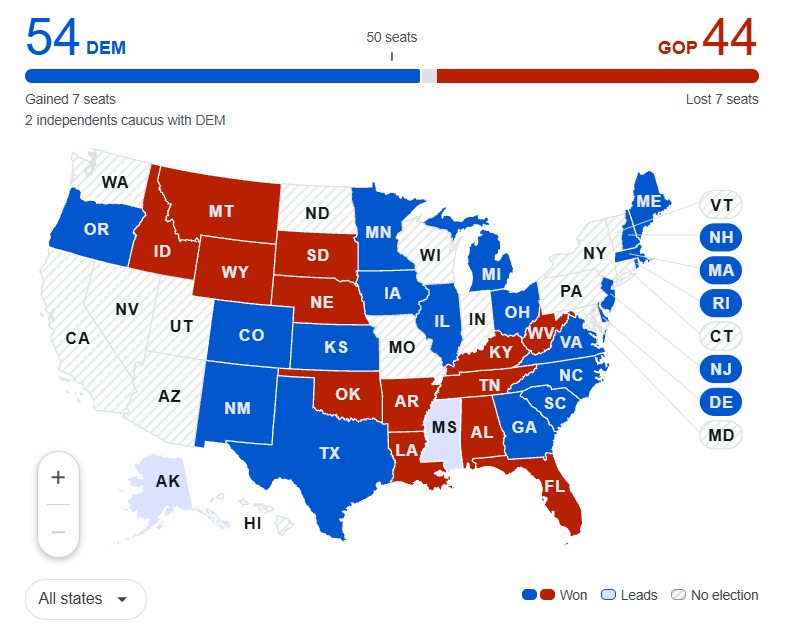
The result amounted to a referendum on President Donald Trump’s second term, with analysts pointing to the administration’s war with Iran, climbing grocery and gas prices, and broader anxiety about the economy as the forces that pushed traditionally red territory into Democratic hands. By early Wednesday, Democrats had flipped at least seven Senate seats, enough to secure a working majority of 51 or more, while also reclaiming the House after picking up dozens of districts nationwide.
Few results carried more symbolic weight than Minnesota, where Lieutenant Governor Peggy Flanagan defeated Republican Michele Tafoya, a former NFL sideline reporter, to become the first Native American woman ever elected to the United States Senate. Flanagan, an enrolled citizen of the White Earth Band of Ojibwe, has spent her career pushing for tribal sovereignty and children’s welfare, following in the footsteps of her father, a well known White Earth activist. Only four Native American men had served in the Senate before her. “Minnesota, you just beat Donald Trump again,” Flanagan told supporters at her victory party in St. Paul, a nod to the state’s consistent rejection of the president at the ballot box.
In Michigan, Abdul El-Sayed made history of his own, becoming the first Muslim ever elected to the Senate after defeating former Republican Congressman Mike Rogers. The 42-year-old former public health official ran on universal health coverage and a pledge to strip corporate money out of politics, and he did it while absorbing months of Islamophobic attack ads that Democratic colleagues, including outgoing Michigan Senator Elissa Slotkin, publicly condemned. Slotkin, who is Jewish, framed the dual outcome as a milestone in itself, noting that Michigan would now be represented by one Jewish and one Muslim senator at the same time. El-Sayed leaned into the moment at his Detroit victory rally, telling supporters who had taken a chance on an underdog candidacy that the win belonged to them.


New Hampshire sent its own first to Washington. Democratic Congressman Chris Pappas beat former Republican Senator John Sununu to become the first openly gay man elected to the Senate, a milestone that arrived nearly a decade after Tammy Baldwin became the chamber’s first openly gay member in any capacity. Pappas’s win also kept a crucial swing state firmly in Democratic hands heading into the next presidential cycle.
The Latina and Latino wins came largely at the top of state tickets rather than in Senate races this cycle, but they were no less historic. In Texas, state representative Gina Hinojosa unseated Governor Greg Abbott to become the first Latina governor in the state’s history and the first Democrat elected to statewide office there since Ann Richards left office in the 1990s. Her win arrived on the same night fellow Democrat James Talarico defeated Attorney General Ken Paxton in the state’s most expensive Senate race ever, flipping a seat Republicans had held for a generation. Out west, former Health and Human Services Secretary Xavier Becerra won California’s governorship, becoming the first Latino elected to lead that state. Nevada’s Catherine Cortez Masto, who broke her own barrier as the Senate’s first Latina member back in 2016, remains in the chamber as colleagues like Illinois’s incoming Senator Juliana Stratton join the growing bloc of women of color in the body. Stratton’s victory makes her the fifth Black woman ever elected to the Senate and gives Illinois two female senators of color serving simultaneously alongside Tammy Duckworth.
Other marquee races told a similar story. Roy Cooper reclaimed North Carolina for Democrats for the first time since 2008. Sherrod Brown returned to the Senate from Ohio two years after losing his seat. Adam Hamilton became the first Democrat to win a Kansas Senate race in roughly ninety years, and Josh Turek flipped Iowa. In Georgia, former Atlanta Mayor Keisha Lance Bottoms was elected the nation’s first Black woman governor.
The scale of the defeat stunned Republicans, and the party’s two most prominent figures offered noticeably different explanations. President Trump, who was not on the ballot, insisted on social media that Republicans would have won “in a landslide” had his name appeared, while separately blaming Fox News for failing to adequately support GOP candidates. Vice President JD Vance took a more sober, and more pointed, tone. In a lengthy post on X the morning after the results came in, Vance argued that voter anger over the administration’s war with Iran was the single biggest factor behind the rout, writing that a meaningful share of people who had backed the Trump-Vance ticket in 2024 crossed over to Democrats this time. He acknowledged the loss would cost Republicans the Senate for years and urged the party to have an honest reckoning rather than look for scapegoats. Trump later told reporters he agreed with his vice president’s assessment and said he remained open to working with the incoming Democratic majority, while also making clear he would not hesitate to use his veto pen.
With control of both chambers now settled, attention in Washington is already shifting to what a Democratic Congress does with its new leverage. Party strategists expect aggressive oversight of the administration, renewed fights over health care costs and immigration policy, and a push to confirm judicial nominees that stalled under GOP control. For the incoming class of historic firsts, the test now moves from campaigning to governing, with voters who broke decades of precedent at the ballot box waiting to see what changes in Washington as a result.