 By
Famous tools like Semrush and Ahrefs are now fumbling because Google is quietly poisoning the search results these platforms rely on to build their numbers. Yup, you heard that right. As a fellow digital marketer, I want to help end, or at least loosen, the grip that third-party metrics have on how this industry makes decisions.
You can ask why. Because Google itself has warned, more than once, that third-party website authority scores, spam scores and traffic estimates are not something it recognizes or endorses. Google has said plainly that there is no such thing as an official “spam score” for a website. That number is a tactic these platforms built to sell subscriptions, not a reflection of how Google actually evaluates a site. And now there is fresh, documented proof that the raw data feeding those tools cannot even be trusted at face value.
What’s actually happening with Google’s search results
For years, rank trackers, SEO platforms and SERP scraping tools have pulled large volumes of search results pages to build their databases of rankings, domain authority scores, and competitor visibility reports. Google has been pushing back against that kind of automated scraping for a while, first through CAPTCHAs and harder blocks, then by removing the ability to pull 100 results on a single page.
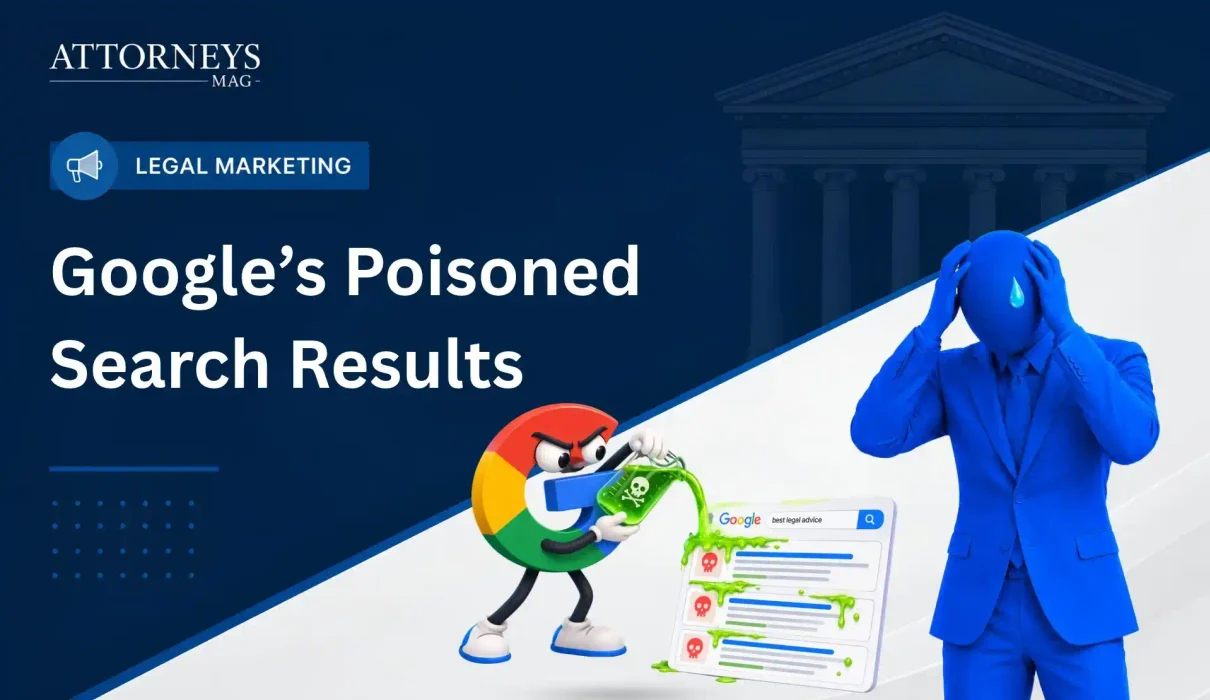
Since mid-September 2026, the tactic changed. Instead of blocking scrapers outright, Google began quietly serving a results page that looks completely normal but has had many of its organic listings swapped for irrelevant content, often social media profiles and forum threads standing in for the sites that actually rank. BrightLocal reported that this newer measure serves a complete, normal-looking results page where many of the actual rankings are replaced with results that have nothing to do with the real page, and the issue tends to show up on page two and beyond rather than on the first page of results.
Independent research backs this up with real numbers. A study of 27.5 million Google results pages across 49 countries found that 8 percent came back poisoned since mid-September, compared to a baseline of just 0.17 percent before the change, with some days spiking to roughly a quarter of all pages affected. On a normal day, a tracked keyword’s results stay fairly stable from one check to the next. On a poisoned page, that stability largely disappears.
What makes this especially relevant for digital marketers is that the big platforms have had to own up to it themselves. Semrush confirmed to industry reporters that it had been seeing this inaccurate-results problem since late summer, and Ahrefs later put the share of affected results anywhere between 5 and 20 percent depending on which data provider was behind the numbers. This is not a rumor or a conspiracy theory floating around a marketing forum. It is an admitted, industry-wide problem affecting the very tools that law firms and legal marketing agencies lean on every single day to justify budgets, prove rankings, and score a website’s so-called “authority.”
Why this matters more for legal marketing than almost anywhere else
Here is the part that should worry every legal marketer reading this. Clients, including law firm partners who have no background in SEO, have slowly been trained to trust a number on a Semrush or Ahrefs dashboard more than the judgment of the agency or marketer actually doing the work. A domain authority score, a spam score, a traffic estimate, these numbers get treated as gospel in pitch meetings and monthly reporting calls, even though Google has never confirmed any of them and now we know the underlying data can be scrambled without warning.
This was not a decision digital marketers or agencies made on their own. It happened gradually, as third-party tools marketed their scores directly to business owners and in-house teams, positioning themselves as the objective referee between agency and client. The result is a strange situation where the people doing the actual optimization work are now arguing with their own clients over numbers pulled from a tool that the tool’s own maker admits can be feeding everyone bad data.
This is a genuinely sad reality for the digital marketing community, and it hits legal marketing especially hard because law firm clients tend to be risk-averse, numbers-driven, and quick to question an agency’s recommendations if a third-party score moves in the wrong direction, even for reasons that have nothing to do with the firm’s actual visibility.
What legal marketers should take from this
A few practical shifts are worth making now, while this story is fresh:
- Treat domain authority, spam score and similar third-party metrics as directional, never as proof of anything. They were never Google metrics to begin with.
- Lean harder on first-party data: Google Search Console, Google Business Profile insights, and actual call and lead tracking tell you far more about how a law firm is performing than any third-party dashboard ever will.
- When reporting to clients, explain the limits of these tools honestly. A firm that understands why a score moved, rather than panicking over it, becomes a more trusted advisor than one hiding behind a dashboard.
- Keep an eye on how this story develops. Both BrightLocal and the wider SEO press are tracking it closely, and the scale of the problem has already forced Google’s data vendors to change how they filter results.
For more background on how this situation unfolded, BrightLocal’s reporting on Google’s anti-scraping measures and the coverage from Search Engine Land on Semrush’s confirmation of poisoned results are both worth reading in full.
If your firm wants to understand how this kind of industry shift affects your own visibility, our pieces on SEO for law firms and advertising guides for the U.S. Law firms go deeper into what to actually measure instead of chasing a third-party score.
At the end of the day, no tool, free or paid, gets to decide how Google sees your firm’s website. Only Google does, and right now, Google is making sure of that in a very literal way.
Last updated on: October 28, 2026