 By
By The Flo app class action lawsuit ended in a $59.5 million settlement with Flo Health, Google, and Flurry. If you logged a period or pregnancy in the Flo Period & Ovulation Tracker between November 1, 2016 and February 28, 2019, you can file a claim until 11:59 p.m. Pacific Time on October 15, 2026. You do not need a receipt or a screenshot. The objection deadline is October 8, 2026, and the court holds its final approval hearing on October 29, 2026. Meta did not settle, and the case against Meta is still open.
The Flo app class action lawsuit began in 2021 as a federal privacy case in San Francisco. Users said the Flo period tracker sent their most private entries, such as cycle dates and pregnancy plans, to outside companies through code built into the app. Four defendants were named: Flo Health, Google, Flurry, and Meta. Three of them paid to settle. Meta went to trial and lost.
This guide covers the full Flo lawsuit, from the first complaint to the deadlines on the calendar today. It explains who qualifies, how to file the claim form, what a payment may look like, what the Meta verdict means, and how to avoid fake claim websites. It also covers the separate Flo class action in Canada and the legal issues that matter to attorneys and privacy professionals. Attorneys Magazine covers active lawsuits and settlements every week, and this article is updated as the court rules.
Flo App Class Action Lawsuit at a Glance
These are the facts most readers search for first. Dates and figures are current as of October 3, 2026.
| Item | Detail |
|---|---|
| Case name | Frasco et al. v. Flo Health, Inc. et al., Case No. 3:21-cv-00757-JD |
| Court and judge | U.S. District Court, Northern District of California, Judge James Donato |
| Defendants | Flo Health, Google, Flurry, and Meta Platforms |
| Settlement total | $59.5 million (Google $48 million, Flo $8 million, Flurry $3.5 million) |
| Class period | November 1, 2016 to February 28, 2019 |
| Who qualifies | U.S. users of the Flo app who entered menstruation and/or pregnancy information during the class period |
| Objection deadline | October 8, 2026 |
| Claim form deadline | October 15, 2026, 11:59 p.m. Pacific Time online, or postmarked by that date if mailed |
| Final approval hearing | October 29, 2026, 11:00 a.m., Courtroom 11, 450 Golden Gate Avenue, San Francisco |
| Official claim website | PeriodTrackerDataPrivacyLitigation.com |
| Meta status | Jury found Meta liable on August 1, 2025. A request for judgment is set for hearing on October 29, 2026. |
Source for the table: the official case page posted by co-lead counsel Labaton Keller Sucharow, the official settlement website, and the Top Class Actions settlement summary.
What Is the Flo App Class Action Lawsuit About?
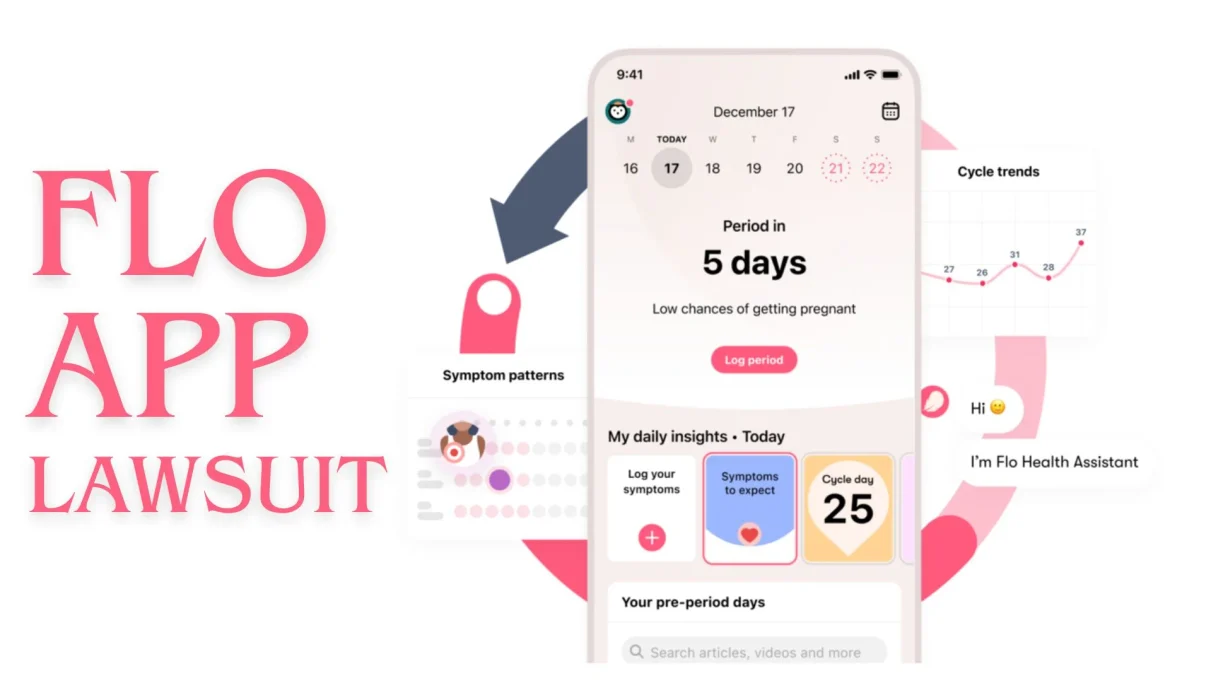
Flo is a period, ovulation, and pregnancy tracking app. In its own words, it serves about 76 million monthly active users, according to Flo’s July 2025 press statement. People use the app to log cycle dates, symptoms, sexual activity, and whether they are trying to get pregnant. That is health information, and users expected it to stay private.
The plaintiffs said it did not. Their complaint argued that Flo built software development kits, called SDKs, from Google, Meta, and Flurry into the app. An SDK is a package of code from another company that an app developer adds to get a service, such as analytics or advertising tools. Plaintiffs said these SDKs recorded what users typed into Flo and passed it to the companies that made them, without user consent. Labaton’s case summary describes the claim as letting Facebook, Google, and others eavesdrop on confidential in-app health communications.
The case rested on several legal theories. According to the HIPAA Journal’s settlement report, the claims included violations of the California Invasion of Privacy Act (CIPA), the California Confidentiality of Medical Information Act (CMIA), and the federal Stored Communications Act, along with common law invasion of privacy, breach of contract, and unjust enrichment.
Judge James Donato appointed co-lead counsel in October 2021, and on May 19, 2025, he certified a nationwide class for certain claims plus a California subclass. Class certification is the step that turns individual complaints into a case that can be tried and settled for everyone in the group. If you want the basics of how that process works, read our explainer on what a class action lawsuit is and how it works.
Who Are the Defendants in the Flo Lawsuit?
Four companies were sued. Each one ended up in a different place.
| Defendant | Alleged role | Result |
|---|---|---|
| Flo Health | Built the tracking app and allegedly let outside SDKs collect user entries | Settled for $8 million during trial. No admission of wrongdoing. |
| Provided analytics code used inside the app | Settled for $48 million before the jury returned a verdict. Denies wrongdoing. | |
| Flurry | Analytics company that allegedly received app data | Settled for $3.5 million in March 2025. |
| Meta | Provided SDK code that allegedly recorded in-app entries for its advertising business | Did not settle. Jury found Meta liable on August 1, 2025. |
The settlement totals come from the settlement coverage on ClassAction.org, and the Meta verdict comes from Labaton’s case page. The jury verdict applies only to Meta.
Flo App Lawsuit Timeline From 2021 to October 2026
The case moved slowly for four years and then fast in the summer of 2025. This timeline pulls together the dates that matter.
| Date | What happened |
|---|---|
| January 2021 | The FTC announces a proposed settlement with Flo Health over its sharing of user health data. The federal class action is filed in San Francisco the same month. |
| March 5, 2021 | Canadian lawyers file the first statement of claim against Flo in Ontario. |
| June 22, 2021 | The FTC finalizes its order against Flo Health. |
| October 12, 2021 | Judge Donato appoints co-lead counsel in the consolidated U.S. case. |
| March 2025 | Flurry agrees to a $3.5 million settlement. |
| May 19, 2025 | The court certifies a nationwide class and a California subclass. |
| July 2025 | Google agrees to settle. Trial opens on July 21. Flo announces its settlement on July 31, later set at $8 million. |
| August 1, 2025 | The jury finds Meta liable under the California Invasion of Privacy Act. |
| September 2025 | The judge denies Meta’s post-trial motions. Reuters reports the combined Google and Flo payment of $56 million. |
| April 22, 2026 | The court enters its order preliminarily approving the Google and Flo settlements. |
| June 2026 | The claims website goes live. |
| August 20, 2026 | Class counsel file for final approval and request attorneys’ fees. |
| September 14, 2026 | Plaintiffs ask the court to enter a partial judgment against Meta of about $1.1 billion. |
| October 8, 2026 | Deadline to object to the settlements. |
| October 15, 2026 | Deadline to file a claim. |
| October 29, 2026 | Final approval hearing and hearing on the request for judgment against Meta. |
Sources for these dates include the FTC case page, Foreman & Company’s Canadian case page, Reuters, Settlement Insight’s case timeline, and Open Class Actions.
The FTC Case Against Flo Health Is Separate From the Class Action
Many readers confuse the two matters. The Federal Trade Commission brought its own case against Flo Health, and it ended years before the class action reached trial. In January 2021 the agency announced that Flo had settled allegations that it shared users’ health information with outside data analytics providers after promising to keep that information private. The FTC announced the proposed order on January 13, 2021 and finalized it on June 22, 2021. The agency’s case page lists the matter as closed under file number 192 3133.
The FTC order set rules for how Flo handles health data going forward. It requires Flo to obtain users’ affirmative consent before sharing health information, to submit its privacy practices to an independent review, and to notify affected users about the past disclosures. The order did not create a refund program for users. That gap is part of why private plaintiffs went to court. If you only received a notice from the FTC case, you still need to file a claim in the class action settlement to be paid.
Flo Period App Class Action Lawsuit Settlement: How the $59.5 Million Works
Three defendants contributed to one pool of money. Google pays $48 million, Flo pays $8 million, and Flurry pays $3.5 million, for a total of $59.5 million. None of the three admitted wrongdoing. Under the terms reported by ClassAction.org, class members who submit a timely and valid claim receive a pro rata share, which means an equal share of the net fund divided by the number of valid claims.
California residents can receive more. A California class member who provides reasonable documentation of California residency during the class period may receive twice the share of a member from another state. A valid California address is the example given in coverage of the claim process.
The fund shrinks before anyone is paid. Court-approved attorneys’ fees, litigation expenses, service awards for the named plaintiffs, and the cost of administering the settlement all come out first. Class counsel asked the court for $19,366,666.67 in fees, according to Settlement Insight’s summary of the August 20, 2026 filing. That figure equals one third of the Google and Flo settlements and 20 percent of the Flurry settlement, a blended rate of 32.5 percent. The judge has not ruled on the request. Subtracting that amount from $59.5 million leaves about $40.1 million before administration costs and service awards, which is simple arithmetic and not a figure from the court.
Who Qualifies for the Flo App Class Action Settlement?
Searches for the class action lawsuit Flo app users can join usually come down to one question: do I qualify? The answer depends on where you used the app, when you used it, and what you entered. Under the official case materials, you are a member of the nationwide class if both of these are true:
- You used the Flo app in the United States at any time between November 1, 2016 and February 28, 2019.
- You entered menstruation and/or pregnancy information into the app during that time.
You are also a member of the California subclass if you used the app in California in that period, lived in California during that time, and entered the same kind of information.
Three groups of people do not qualify for this settlement:
- People who opted out during the 2025 notice period. The opt-out deadline was July 20, 2025, and it has passed.
- The defendants, their officers and directors, the judges on the case, and class counsel.
- People who used Flo only outside the class period or who never logged menstruation or pregnancy data in the app. Canadian users have a separate case, covered below.
If you never received a notice, you can still file. The claim form can be completed without a unique ID and PIN, and no proof of app use is required.
Flo App Class Action Lawsuit Claim Form: How to File Before October 15, 2026
The deadline is close. As of October 3, 2026, the objection deadline is five days away and the claim deadline is twelve days away. The claim takes a few minutes and costs nothing. Follow these steps.
- Open the official claim site. Go to PeriodTrackerDataPrivacyLitigation.com. This is the only legitimate portal. The settlement administrator is A.B. Data, Ltd.
- Enter your notice ID and PIN if you have them. If you received a notice by email or mail, it contains a unique ID and PIN. If not, choose the option to file without one.
- Fill in your contact details and eligibility answers. You will confirm that you used the Flo app in the class period and entered menstruation and/or pregnancy information.
- State whether you lived in California. If you did, provide the residency information the form asks for so you can qualify for the larger California share.
- Pick how you want to be paid. Reported payment options include PayPal, Venmo, Apple Pay, direct deposit, or a paper check.
- Sign the certification and submit. You sign under penalty of perjury. Save the confirmation page or email.
You can also mail a paper claim form. It must be postmarked by October 15, 2026. If a form is incomplete, the administrator contacts the claimant to fix it. Online filers have until 11:59 p.m. Pacific Time on the deadline day, but filing early leaves room to fix any problem with the form.
Claim windows in class action settlements close for good. Our guide to the Celsius energy drink lawsuit, for example, covers a $7.8 million settlement whose claim period has already ended. Do not plan on a second chance here.
Should You Object to the Flo Settlement?
Class members who stayed in the case can object in writing by October 8, 2026. An objection tells the judge you think the deal, the fee request, or the payment structure is unfair. It is separate from filing a claim, and you can do both. The long form notice on the official website explains what an objection must contain and where to send it. Read it before you write anything, because an objection that misses a required item can be rejected.
How Much Money Will You Get From the Flo Class Action Settlement?
Nobody knows the exact amount yet, and the numbers circulating online vary widely. The payment depends on the net fund and on how many people file valid claims. More claims mean smaller checks. Our guide to the Poppi settlement, for example, explains the same pro rata mechanic in a consumer product case.
| Source | Estimate | Notes |
|---|---|---|
| Class counsel filing, August 20, 2026 | $31.94 average if 10% of the class files; $12.69 if 25% files | Reported by Settlement Insight |
| Class counsel attorney Carol Villegas | $25 to $96 average per claimant, with California claimants receiving double | Reported by AllAboutCookies, made before the final claim count |
| Social media posts and some websites | $200 to $400 | Not supported by the court filings |
Treat any promise of a fixed amount as a red flag. The administrator is due to report the final claim count to the court, and that number sets the real payment. Payments are not sent immediately either. They follow final approval and the resolution of any appeals, and the official notice warns the wait can take a year or more, so payments are likely in 2027, according to Open Class Actions.
| RELATED READINGS IN ATTORNEYS MAGAZINE What Is a Class Action Lawsuit and How Does It Work: The basics of certification, claims, and payouts. Intoxalock Lawsuit: Call Recording Class Action and Data Breach Updates: A California call recording case and the later data breach suit. Chime Lawsuit 2026: Data Breach Class Action Guide: Who qualifies and what payouts usually look like. Poppi Lawsuit 2026: $8.9 Million Settlement and Claims: How pro rata payments depend on the number of claims. |
The Meta Verdict: Why the Flo Lawsuit Is Not Over
Meta is the one defendant that did not settle. Meta Platforms chose to go to trial, and on August 1, 2025, a San Francisco jury found it liable under the California Invasion of Privacy Act for recording users’ reproductive health entries. Bloomberg Law reported that the verdict used a 1960s era wiretapping statute that carries a $5,000 penalty per violation. The jury also found that Flo users never consented to having their data recorded, even though Meta relies on broad privacy agreements that allow wide tracking.
Judge Donato denied Meta’s post-trial motions in September 2025. The remaining question is damages. At a September 2025 hearing, the judge signaled that the exposure could approach $8 billion, based on $5,000 per class member and an estimate of about 1.6 million eligible California members, according to Settlement Insight.
The newest filing is smaller. On September 14, 2026, plaintiffs moved for a partial final judgment of about $1.1 billion for roughly 222,000 California residents, according to MLex. Meta filed its opposition on September 28, and Law360 reported that Meta called the proposed judgment a “Frankenstein’s monster” that violates its due process rights. Meta’s argument, in the MLex summary, is that it has a right to present defenses when class members actually come forward, and a judgment entered now would skip that step. The two damages figures rest on different class counts, and the October 29 hearing will show which approach the judge accepts.
Plaintiffs also asked on September 9, 2026 for approval of a claims process for money from the Meta verdict. Meta opposed that motion on September 23. There is no Meta claim form yet. The official settlement website says eligible people will be contacted later, and filing a claim in the Google, Flo, and Flurry settlement does not affect that right. Reports indicate Meta intends to appeal once a judgment is entered, so a payment from Meta, if one comes, is likely a long way off.
What the Flo Rulings Mean for Privacy Law and Class Action Practice
Attorneys and compliance teams are watching this case for four reasons.
- Wiretap statutes work against app trackers. The CIPA theory succeeded at trial against an ad platform that received data through an SDK. That gives plaintiffs a model for other health app and website tracking cases, which is why privacy dockets have filled with similar suits.
- Consent evidence decides cases. The jury rejected the argument that general privacy terms amounted to consent for recording sensitive health entries. Defendants that rely on boilerplate should expect that argument to be tested.
- The CMIA claim was weak on evidence. Flo says the judge told the parties the central CMIA claim would be dismissed for lack of evidence the day before it settled. That is Flo’s account in its press statement, and plaintiffs did not describe the ruling the same way.
- Defendants split. Flurry, Google, and Flo each settled on different timelines and at different prices, while Meta tried the case. The result gives a rare side by side view of what settlement and trial can produce on identical facts.
Other California call recording and tracking cases rest on the same statute. Our report on the Intoxalock lawsuit covers a California call recording class action, and the Chime lawsuit guide shows the contrast with data breach claims, which depend on a different set of laws and usually settle for a different kind of relief.
Flo Class Action Lawsuit in Canada
Canadian users of the app are in a separate case. According to Foreman & Company, one of the firms prosecuting it, the Canadian action alleges that Flo collected and shared sensitive reproductive health information without consent, contrary to its privacy policies and contracts. The proposed class covers people who used the Flo: Health & Period Tracker app between June 1, 2016 and February 23, 2019.
The procedural history so far:
- A statement of claim was issued in Ontario on March 5, 2021 for Canadians outside Quebec.
- The Ontario action was stayed on January 6, 2022, and the litigation proceeds in British Columbia for a national class excluding Quebec.
- The British Columbia court certified the class in decisions released in March 2024 and May 2025. Flo has appealed, and no appeal date has been set.
- A Quebec class action was authorized to proceed on November 30, 2022.
There is no Canadian settlement to claim yet. Canadians can register for updates through the firms listed on the Foreman page. The U.S. claim form is for U.S. users only.
How Flo Health Responded to the Class Action Lawsuit
Flo has consistently denied wrongdoing. In its July 31, 2025 press statement, the company said it always maintained that the claims lacked merit, that the settlement includes no admission of wrongdoing, and that it has never sold user data. It also pointed to its Anonymous Mode feature, which it says lets people use the app without tying entries to their identity.
Google and Flurry also settled without admitting liability. Those denials are part of the record and do not change what the court decides on final approval. A settlement is a negotiated resolution, not a finding of fault. The only liability finding in the case so far is the jury verdict against Meta.
How to Spot a Fake Flo Lawsuit Claim Website
High profile class actions attract scam sites within days. Use these checks before you enter any personal information.
- Check the web address. The official claim portal is PeriodTrackerDataPrivacyLitigation.com. Social media links and ads that point anywhere else should be ignored.
- Never pay to file. Legitimate settlements do not charge processing, membership, or shipping fees to submit a claim or receive money.
- Distrust a promised amount. The final payment is unknown until the claim count is in. Any site that guarantees $200, $400, or any exact figure is guessing or selling something.
- Be careful with lead forms. Some settlement information sites collect your name and phone number to pass to law firms. You never need to give that information to file the claim.
If you have a question about the real settlement, you can contact the administrator at info@PeriodTrackerDataPrivacyLitigation.com, or class counsel at Labaton Keller Sucharow by email at settlementquestions@labaton.com or by phone at 1-888-219-6877, as listed on Labaton’s case page.
How to Protect Your Health Data on Period Tracking Apps
The Flo lawsuit is about conduct that ended in 2019, but the same questions apply to any health app today. A few practical steps lower your exposure.
- Read the privacy policy section on third parties and advertising partners before you log sensitive entries.
- Turn off ad personalization and analytics sharing in the app and in your phone settings where the option exists.
- Use an anonymous or local-only mode if the app offers one, and log only what you need.
- Review app permissions, and remove apps you no longer use.
- Ask the company to delete your data. California residents have deletion rights under state privacy law, and many companies honor requests from other states as well.
Do You Need a Lawyer to Join the Flo Class Action Settlement?
No. Class members do not need to hire a lawyer to file a claim, and filing costs nothing. The court has already appointed class counsel to represent the class, and their fees come out of the settlement fund if the judge approves them. You would speak to your own lawyer only if you wanted to object with legal help, if you have a separate claim that is not part of this class, or if you want advice on how the Meta verdict could affect you as a California resident. Our lawsuits section and U.S. legal news page track other open settlements where deadlines are close.
Flo App Class Action Lawsuit FAQ
What is the Flo app class action lawsuit?
It is a federal privacy lawsuit, Frasco v. Flo Health, filed in the Northern District of California in 2021. Users said the Flo period tracker shared their menstruation and pregnancy entries with Google, Meta, Flurry, and others through built-in code without consent. Flo, Google, and Flurry settled for $59.5 million in total. A jury found Meta liable.
How much is the Flo class action lawsuit settlement?
The combined settlement is $59.5 million. Google pays $48 million, Flo pays $8 million, and Flurry pays $3.5 million. Fees, expenses, service awards, and administration costs come out before payments are made.
Who qualifies for the Flo app class action settlement?
You qualify if you used the Flo app in the United States between November 1, 2016 and February 28, 2019 and entered menstruation and/or pregnancy information during that period. California residents may receive a larger share if they document their California residency.
What is the Flo class action claim deadline?
The claim deadline is October 15, 2026. Online claims are due by 11:59 p.m. Pacific Time, and mailed claim forms must be postmarked by that date. The objection deadline is October 8, 2026.
How do I file the Flo app class action lawsuit claim form?
Go to PeriodTrackerDataPrivacyLitigation.com, enter your unique ID and PIN if you have one, answer the eligibility questions, choose a payment method, and sign the certification. You can also mail a paper claim form. No receipt or screenshot is required.
How much money will I get from the Flo settlement?
The amount is not set. Class counsel estimated an average of $31.94 per class member if 10 percent of the class files and $12.69 if 25 percent files. California claimants may receive double. Claims of $200 to $400 online are not supported by the filings.
When will Flo settlement payments be sent?
Payments follow final approval and the end of any appeals. The final approval hearing is October 29, 2026, and payments are likely in 2027.
Is the Flo settlement real or a scam?
It is a real, court-certified class action. The only legitimate claim portal is PeriodTrackerDataPrivacyLitigation.com. You never have to pay to file a claim.
Did Meta settle in the Flo lawsuit?
No. Meta went to trial, and a jury found it liable on August 1, 2025. Plaintiffs have asked the court to enter a judgment of about $1.1 billion for roughly 222,000 California residents, and Meta opposes the request. The court will hear it on October 29, 2026.
Can I file if I used Flo after February 2019?
Only use between November 1, 2016 and February 28, 2019 is covered by this settlement. Entries you made after that date do not count toward eligibility.
Is there a Flo class action lawsuit in Canada?
Yes. A separate Canadian class action is proceeding in British Columbia and Quebec for people who used the Flo: Health & Period Tracker app between June 1, 2016 and February 23, 2019. It has not settled.
Can I still opt out of the Flo settlement?
No. The opt-out deadline passed in July 2025. You can still file a claim or object, but you cannot exclude yourself now.
Flo Class Action Lawsuit: What to Do Now
If you used Flo between late 2016 and early 2019 and logged a period or pregnancy, file your claim before October 15, 2026. It takes minutes, requires no proof, and cannot be reopened after the deadline. If you disagree with the settlement terms, the objection deadline is October 8. After that, the next date to watch is October 29, when Judge Donato hears the final approval request and the request for judgment against Meta.
The Flo lawsuit has already shaped how courts treat health app tracking, and the Meta ruling will add more. Attorneys Magazine will update this article after the October 15 claim deadline and again after the October 29 hearing.
Last Updated on: October 05, 2026