
 By
Six months ago I came across a legal platform that looked, on paper, like a marketing dream. Daily traffic numbers that most firms would kill for. So I pulled up the top-performing pages to see what content was converting so well.
What I found instead was nonsense. Pages stuffed with made-up words like “zelimsnet xicanmaledyaz” and “about votanizhivoz.” No legal guidance, no case studies, nothing a human being would ever type into Google. And yet the analytics dashboard showed hundreds of visits a day.
It didn’t take long to figure out what was actually happening. The traffic wasn’t earned. It was manufactured by bot servers, most of them hosted overseas, hitting the site on autopilot.
This isn’t a one-off. It’s a pattern showing up across legal marketing right now, and firms are paying full retainer prices for it without knowing. Here’s how the scam works, why it’s quietly wrecking your SEO in the background, and what to check before you sign your next invoice.
What the Screenshot Actually Shows
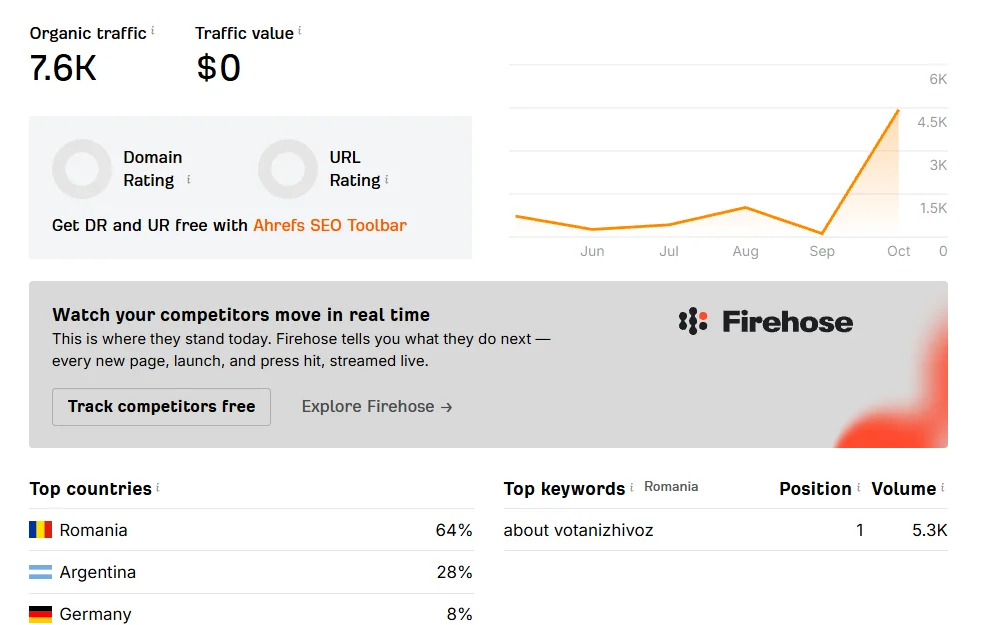
A few details worth sitting with before you move past this chart:
- The spike isn’t gradual. Traffic sat under 2K for months, then jumped past 4.5K inside a single reporting window between September and October. Real organic growth from content and backlinks doesn’t move like that. A sudden vertical line almost always means something was switched on, not earned.
- $0 traffic value on 7.6K visits. This is the number that should stop any marketing director cold. Ahrefs estimates traffic value based on what that traffic would cost to buy through paid search. Legitimate commercial traffic, even on a slow month, carries some dollar value. Zero means none of these visits are landing on pages or keywords anyone would ever pay to rank for.
- The top keyword isn’t a keyword. “about votanizhivoz” sits in position one with a reported 5.3K monthly search volume. That’s not a long-tail legal term or a branded search. It’s a string with no meaning in any language, sitting at the top of a keyword report as if it were in demand.
- The geography doesn’t match the business. Romania, Argentina, and Germany made up the entire top-country breakdown. For a firm marketing to local clients in the US, that’s not an audience. It’s a routing pattern.
Taken together, this isn’t a messy analytics report. It’s what a bot-driven traffic pipeline looks like from the outside, and it’s exactly the kind of screenshot you should be asking your own agency to produce and explain, broken down by keyword, country, and date.
It didn’t take long to figure out what was actually happening. The traffic wasn’t earned. It was manufactured by bot servers, most of them hosted overseas, hitting the site on autopilot.
This isn’t a one-off. It’s a pattern showing up across legal marketing right now, and firms are paying full retainer prices for it without knowing. Here’s how the scam works, why it’s quietly wrecking your SEO in the background, and what to check before you sign your next invoice.
How the Fake Traffic Gets Built
The mechanics are simple once you see them. An agency sets up a botnet, often routed through compromised servers or cheap residential proxies spread across multiple countries, and points it at invented, nonsense keywords on a throwaway page. Because nobody else on earth is searching for that exact string of gibberish, the page ranks instantly. There’s no competition for a term nobody would ever type.
From there, the bots hit the page on a loop. The goal isn’t to fool a human. It’s to fool the analytics report your agency hands you at the end of the month.
Why Agencies Do It
Bots don’t sign retainers, but they make a monthly report look great. A firm pushes for fast results, and instead of doing the slow work of real content and local authority building, a shortcut-taking agency flips on a traffic pipeline. The partner gets a PDF with a 300% traffic jump, feels good about the spend, and keeps paying.
Meanwhile the phones don’t ring, because a server farm in another country was never going to call your office about a car accident or a criminal charge.
Vanity Metrics Aren’t Growth
In legal marketing specifically, a raw click is worth nothing on its own. The number that actually matters is client acquisition, not pageviews.
There’s also a real cost to running fake traffic through your site. Google Analytics is built on the assumption that the behavior it’s tracking is human. When bots flood a gibberish page and bounce off instantly, your overall bounce rate climbs and your average session time collapses. Search engines read that pattern as a spam signal, and over time it can drag down rankings on the pages that actually matter, including your core practice area pages.
| Related Readings in Attorneys Magazine Hybrid Engine Optimization Ethical Guide to Review Management for Law Firms |
The GA4 Red Flags Worth Checking Yourself
You don’t need to be a developer to catch this. Pull up your GA4 dashboard and look for:
- Geography that makes no sense. A personal injury firm in Chicago getting a wave of sessions from Vietnam, Indonesia, or Eastern Europe has nothing to do with local search demand.
- Landing pages you’ve never heard of. If traffic is concentrated on URLs with random character strings instead of your practice area pages, that’s not organic interest.
- Session duration near zero paired with high traffic. Real visitors researching a lawyer spend time on a page. Bots don’t.
- A spike with no matching event. No PR push, no new content, no paid campaign, yet traffic doubled overnight.
- Device and browser data that’s suspiciously uniform. A huge batch of sessions all running the same outdated browser version is a tell.
The Three Warning Signs to Watch For
- The unexplained global spike. You operate in one city or state, and your traffic suddenly includes users from countries you’ve never marketed to.
- High traffic, zero conversions. Visits go up, but intake sees no new calls, form fills, or chats.
- The “instant success” promise. Any agency guaranteeing top rankings or a traffic surge inside 30 days is very likely gaming the system. Legitimate legal SEO takes months of content, backlinks, and real authority building, not weeks.
Questions to Ask Your Marketing Agency
If your traffic chart is climbing but your phone isn’t, it’s time for a direct conversation. Don’t accept vague answers wrapped in jargon. Ask for specifics:
- “Can I see the geographic breakdown of our traffic down to the city level?”
- “Which exact landing pages are driving this traffic increase?”
- “What’s our traffic-to-lead conversion rate this month, tied to actual calls and form submissions?”
- “Can you show me the referral source and user-agent data behind this spike?”
- “Are you using any bot traffic filtering in our analytics setup, and can you show me that configuration?”
A legitimate agency will answer all five without flinching. One running a bot pipeline will deflect, get vague, or suddenly get very technical very fast.
What to Do If You Find It
If you confirm synthetic traffic on your site, don’t just fire off an angry email. Pull a traffic export as evidence, check your Google Search Console for manual action notices, and consider a quick technical audit before renewing any contract. If the agency sold this to you as a result, you may also have grounds to dispute the invoice. This is also worth flagging to your state bar’s advertising compliance guidelines, since misrepresenting marketing results to a client can raise its own ethical questions for the agency, if not for your firm directly.
Real growth in legal marketing doesn’t come from a script running overseas. It comes from content real people read, searches real people make, and a reputation built one case at a time. Before your next contract renewal, look past the chart, because the spike might just be a hallway of digital mirrors.
FAQ
How can I tell if my law firm’s website traffic is fake? Check GA4 for traffic from countries outside your service area, landing pages you don’t recognize, near-zero session durations, and a conversion rate that stays flat even as traffic rises.
Can bot traffic actually hurt my SEO rankings? Yes. Search engines track engagement signals like bounce rate and time on page. A flood of bot visits that bounce instantly can drag down how your real, high-value pages are ranked over time.
Is buying traffic illegal? It’s not typically a criminal matter, but it can breach your contract with the agency, violate advertising guidelines for attorneys in your state, and in some cases cross into consumer fraud territory if the agency is knowingly misrepresenting results to bill you.
What’s a normal timeline for real SEO results in the legal industry? Most legitimate legal SEO campaigns take three to six months to show meaningful movement, and longer in competitive practice areas like personal injury or criminal defense. Anyone promising results in a month is cutting a corner somewhere.
My traffic looks normal. Should I still check for this? It’s worth a quarterly check regardless. Bot traffic doesn’t always show up as an obvious spike. Sometimes it’s a steady background hum that’s easy to miss unless you’re looking at geography and session quality specifically.
What should I ask for before signing with a new marketing agency? Ask for a sample GA4 report from a current client (with identifying details redacted), their bot-filtering setup, and references you can actually call.
Not sure if your current agency’s numbers add up? Request a free marketing audit. We’ll pull your real traffic data, check it against your intake numbers, and tell you straight whether you’re getting what you’re paying for.
Last updated on: October 16, 2026